Home
/
Blogs
/
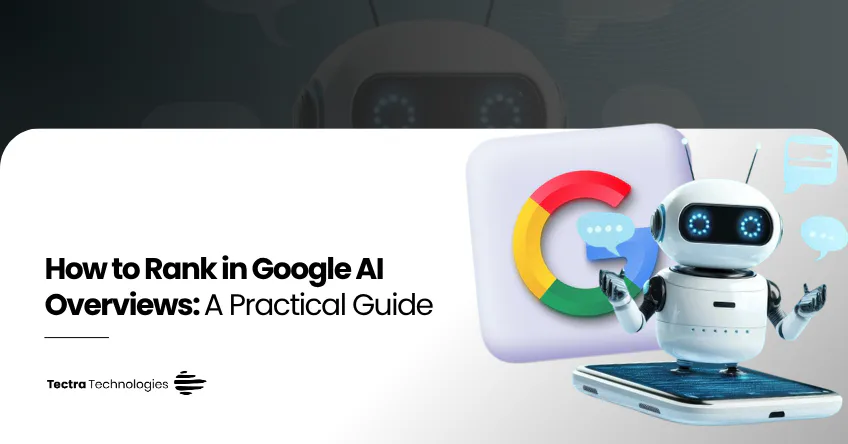
How to Rank in Google AI Overviews: A Practical Guide
Santosh Kumar
Founder & CEO • Updated Oct 1, 2026
AI SEARCH & GOOGLE OVERVIEWS
• 7 min read
How to Rank in Google AI Overviews: A Practical Guide
Key Takeaways
Direct Answers
Answer user queries clearly and directly in the opening sentences to maximize AI Overview citation likelihood.
Topical Authority
AI Overviews prioritize sites that thoroughly cover related subtopics and demonstrate real subject expertise.
Entity Recognition
Backlinks, consistent brand mentions, and schema help Google understand and trust your business entity.
What Are Google AI Overviews?
Search results are no longer just a list of blue links. Google AI Overviews now appear at the top of many search results pages, providing users with a summarized answer generated directly by artificial intelligence. For businesses, content creators, and marketers, this shift changes how people interact with search results. Users often get the information they need without scrolling through multiple websites. If your website is cited within an AI Overview, it can gain strong visibility, credibility, and high-intent referral traffic.

Google AI Overviews are AI-generated snapshots that appear at the top of the search results page. They combine information from multiple web sources to answer complex or multi-part queries quickly. Unlike traditional featured snippets, which usually pull an excerpt from a single webpage, AI Overviews analyze multiple sources, summarize key points, and provide links to the pages that contributed to the answer. Appearing in an AI Overview does not depend on tricks or shortcuts. It requires a solid SEO strategy, clear content, topical authority, and a website Google trusts.
AI Overviews
GOOGLE SEARCH ENGINE
AI snapshots synthesize trusted sources at the top of Google search results.
Core Strategies to Rank in Google AI Overviews
Understand search intent first. AI Overviews appear most often when a query has clear informational intent. Before writing, search your target query and observe how Google answers it. Does it provide steps, a comparison, a definition, or a checklist? Match your format to that intent. If users want quick facts, do not bury them beneath hundreds of words of introduction. Clear Web UX Design and readability prevent the UX mistakes that quietly kill conversions.

Provide direct answers early. AI models look for clear, concise statements that directly answer the user's question. Place the core answer within the first one or two sentences under a clear heading. Follow the answer with supporting details, examples, and context. This inverted pyramid style makes it easy for Google's systems to extract your information.

Build topical authority through Content Marketing. Websites that publish comprehensive content clusters perform significantly better in AI Overviews than those covering isolated keywords. This is why businesses that publish the right content get enquiries without paying for ads.

Create content based on real expertise. Google's quality systems evaluate Experience, Expertise, Authoritativeness, and Trustworthiness (E-E-A-T). Demonstrate firsthand experience, cite credible sources, and ensure your author credentials and organization entity signals are verifiable.

“Appearing in Google AI Overviews requires clear answers, topical authority, quality backlinks, and a website that Google's systems trust as a credible source.”
Actionable Framework for AI Overview Optimization
1
Cover the Topic Comprehensively
Answer logical follow-up questions within the same article to satisfy multi-intent queries in one place.
2
Use Clear Content Structure
Organize content with descriptive H2 and H3 headings, bullet points, and concise definition paragraphs that algorithms parse easily.
3
Earn Relevant Backlinks
Build authority through Guest Post Services and editorial links, as explained in Guest Posting in SEO: A Marketer's Guide.
4
Improve Entity Recognition
Reinforce brand presence and consistent citations so Google connects your brand with your specific industry niche.
5
Publish Original Research & Keep Updated
Provide unique data, original benchmarks, and refresh older content with updated statistics and current developments.
Ranking Dimension
Traditional Search Snippet
Google AI Overview
Source Attribution
Extracts an excerpt from a single high-ranking webpage.
Synthesizes multi-source consensus with multiple citation link cards.
Placement Location
Position 0 featured snippet or organic top 3 links.
Prominent AI snapshot above traditional organic search results.
Content Requirement
Targeted keyword density and matching heading markup.
Direct answer in first 2 sentences, factual clarity, and E-E-A-T.
Authority Evaluation
Page-level PageRank and keyword anchor backlinks.
Topical cluster completeness, entity trust, and site-wide authority.
User Interaction
User scans snippet and clicks through to read the page.
User reads direct AI summary with option to visit citation sources.
Want your content to be included in AI Overviews?
Get an SEO strategy built around search intent, topical authority and real expertise.
Google AI Overviews Frequently Asked Questions
Provide direct, concise answers in the first 1–2 sentences under an H2/H3 question heading, supported by clear data, structured formatting, and established topical authority.
Yes. High-quality contextual backlinks remain a primary indicator of domain authority and trust, directly influencing which domains Google chooses to synthesize into AI Overviews.
Yes. Structured data (Article, FAQPage, Organization, Author) helps Google understand entities and extract accurate facts without ambiguity.

Author

Santosh Kumar
Santosh Kumar

Founder & CEO, Tectra Technologies

Santosh Kumar is the Founder & CEO of Tectra Technologies, a global software development company. With 10+ years of experience, he specializes in technology, business growth, and digital transformation.

His expertise spans UI/UX, web & mobile development, cloud, DevOps, and automation. He is also the Founder & CEO of Elderly Wellness, a health-tech platform focused on elderly care.