ON THIS PAGE
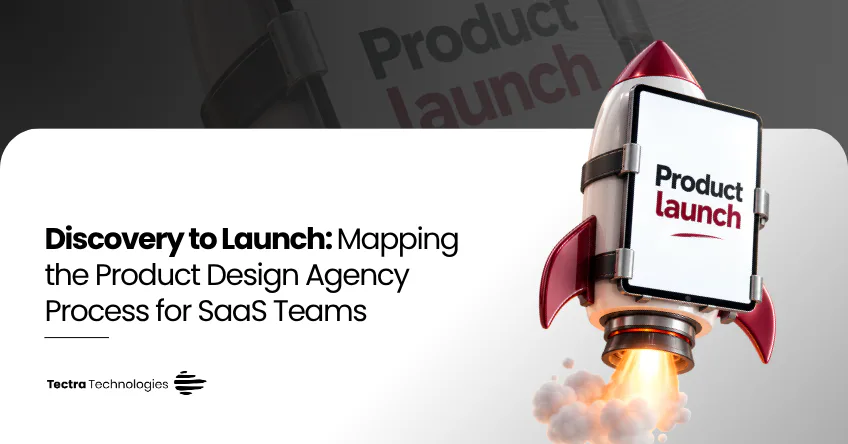
Discovery to Launch: Mapping the Product Design Agency Process for SaaS Teams

Key Takeaways
Problem Before Screens
Discovery should define the problem before any screen gets designed, and flows should be mapped before visual design starts.
Design for Evolution
A SaaS product design agency designs for multi-tenant, evolving products — not static websites.
Validate Before Code
Validation before development saves far more time than validation after launch.
What a Product Design Agency Does Differently for SaaS
Every SaaS product that feels intuitive went through a design process most users never see — and every one that feels clunky usually skipped a stage of it. A structured product design agency doesn't jump from an idea straight to screens; it moves through discovery, flows, visual design and validation in that order, because skipping ahead is how products end up needing a redesign within a year of launch.
SaaS products aren't static. They evolve release after release, serve multiple user roles, and need a design system that holds up as features are added over years, not months. A product design agency working on SaaS designs for that evolution from day one: consistent components, scalable information architecture, and flows that absorb new features without a redesign every quarter.
This is the process our Product Design team runs on every SaaS development engagement.
SaaS products aren't static. They evolve release after release, serve multiple user roles, and need a design system that holds up as features are added over years, not months. A product design agency working on SaaS designs for that evolution from day one: consistent components, scalable information architecture, and flows that absorb new features without a redesign every quarter.
This is the process our Product Design team runs on every SaaS development engagement.
5
Stages from discovery to launch
discovery, flows, visual design, validation and engineering handover.
Digital Product Design Company vs In-House
An in-house designer works well once a product's core flows are stable and iteration is incremental. A digital product design company tends to be the better fit for a new build, a redesign, or a product expanding onto a new platform — situations that need broader process experience and a faster ramp-up than hiring and onboarding an in-house team allows.
That is especially true when a build spans mobile UX design and web UX design at the same time, where one team keeping a shared design system avoids two diverging products.
Product design consulting vs full service. Consulting advises on strategy and process; full-service product design services also execute the wireframes, UI and prototypes. Either way, the discovery-to-validation order matters more than the engagement label.

That is especially true when a build spans mobile UX design and web UX design at the same time, where one team keeping a shared design system avoids two diverging products.
Product design consulting vs full service. Consulting advises on strategy and process; full-service product design services also execute the wireframes, UI and prototypes. Either way, the discovery-to-validation order matters more than the engagement label.
“Skipping ahead is exactly how products end up needing a redesign within a year of launch.”
The Five Stages, Discovery to Launch
1
Discovery and Problem Definition
Stakeholder interviews, competitor review and mapping the core user journey. Skipping this is why products ship polished screens for the wrong workflow — the discipline behind a solid first-twelve-months roadmap.
2
Wireframes and Flows
Low-fidelity wireframes map every screen in the core workflow, with no colour or branding yet — structural problems get caught cheaply here. It mirrors the logic in UX mistakes that quietly kill conversions.
3
UI Product Design and Visual Design
Colour, typography, spacing and component states, built as a reusable design system rather than one-off screens, so new features can be designed faster later.
4
Validation Before Code
Clickable prototypes tested with real target users catch usability issues while they are cheap to fix — the same principle as API-first development.
5
Handover to Engineering and Launch
A complete design system, component specs and flow documentation — not static images — so the build doesn't drift, a mismatch discussed in choosing a mobile build approach.
Stage
Focus
What It Delivers
1. Discovery
The problem, the user and the core journey
Problem statement, user roles, journey map
2. Wireframes and flows
Structure before styling
Low-fidelity screens for the core workflow
3. UI and visual design
A reusable visual language
Design system, components and states
4. Validation
Real users, before development
Tested clickable prototype and fixes
5. Handover
Build fidelity
Specs, flow documentation and design system for engineering
Product Design Frequently Asked Questions
Author

Sai Saranya
Business Development, Tectra Technologies
Sai Saranya leads Business Development at Tectra Technologies, connecting brands with the right digital solutions across software, marketing, and design.
She works with clients to understand their goals and match them with the right technology, marketing, and growth strategies.
SHARE